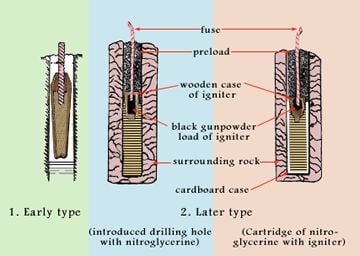
Nitroglycerine is an explosive liquid which was first made by Ascanio Sobrero in 1846 by treating glycerol with a mixture of nitric and sulphuric acid. The reaction which follows is highly exothermic, i.e. it generates heat and will result in an explosion of nitroglycerine, unless the mixture is cooled while the reaction is taking place. Liquid nitroglycerine is colorless if pure. It is soluble in alcohols but insoluble in water. Nitroglycerine is extremely sensitive to shock and in the early days, when impure nitroglycerine was used, it was very difficult to predict under which conditions nitroglycerine would explode. Alfred Nobel studied these problems in detail, and was the first to produce nitroglycerine on an industrial scale. His first major invention was a blasting cap (igniter), a wooden plug filled with black gunpowder, which could be detonated by lighting a fuse. This in turn, caused an explosion of the surrounding nitroglycerine.
Alfred Nobel worked hard to improve nitroglycerine as an explosive that could be used in blasting rock and in mining. He made one of his most important discoveries when he found that by mixing nitroglycerine, an oily fluid, with kieselguhr, the mixture could be turned into a paste. This material could be kneaded and shaped into rods suitable for insertion into drilling holes. He called his paste dynamite and went on to develop a blasting cap which could be used to detonate dynamite under controlled conditions.