Hans Fischer
Biographical
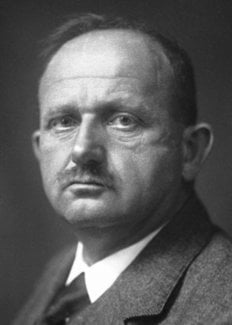
Hans Fischer was born in July 27, 1881 at Hoechst, on the river Main, in Germany. His father was Dr. Eugen Fischer, Director of the firm of Kalle & Co, Wiesbaden, and Privatdozent at the Technical High School, Stuttgart; his mother was Anna Herdegen. He went to a primary school in Stuttgart, and later to the “humanistische Gymnasium” (grammar school with emphasis on the classics) in Wiesbaden, matriculating in 1899. He read chemistry and medicine simultaneously, first at the University of Lausanne and then at Marburg. He obtained his chemistry degree under T. Zincke at Marburg in 1904; two years later, in 1906, a licence for medicine was conferred on him at Munich. In 1908 he qualified for his M.D. under F. von Müller, also at Munich.
Fischer spent his first working years at the Second Medical Clinic in Munich and at the First Berlin Chemical Institute under Emil Fischer. He returned to Munich in 1911 and qualified as lecturer on internal medicine one year later. In 1913 he was appointed E.F. Weinland’s successor at the Physiological Institute (O. Frank) in Munich, where he became a lecturer on physiology. In 1916 Fischer followed the invitation of the University of Innsbruck to succeed Windaus as Professor of Medical Chemistry; from there he went to the University of Vienna in 1918.
From April 1, 1921 until his death he held the position of Professor of Organic Chemistry at the Technische Hochschule (Technical University) in Munich, as successor to Wieland.
Fischer’s scientific work was mostly concerned with the investigation of the constitutive properties of the pigments in blood, bile, and also leaves, as well as with the chemistry of pyrrole. The main reason for the latter investigation was the synthesis of these natural pyrrole pigments. Of special importance was his synthesis of bilirubin. His numerous papers were mostly published in Liebigs Annalen der Chemie and Hoppe-Seylers Zeitschrift für physiologische Chemie.
In recognition of his work in these fields, the title of a “Geheimer Regierungsrat” (Privy Councillor) was conferred upon Hans Fischer in 1925; in 1929 he was awarded the Liebig Memorial Medal; Harvard University bestowed the title of honorary doctor on him in 1936; he received the Davy Medal in 1937. Fischer received the greatest honour of all, the Nobel Prize for 1930, for his work on the chemistry of pyrrole and the synthesis of haemin. In 1935, Professor Fischer married Wiltrud Haufe.
He died on March 31, 1945 in Munich.
This autobiography/biography was written at the time of the award and first published in the book series Les Prix Nobel. It was later edited and republished in Nobel Lectures. To cite this document, always state the source as shown above.
The Nobel Foundation's copyright has expired.Nobel Prizes and laureates
Six prizes were awarded for achievements that have conferred the greatest benefit to humankind. The 14 laureates' work and discoveries range from quantum tunnelling to promoting democratic rights.
See them all presented here.