Award ceremony speech
Presentation Speech by Professor Bengt Nordén of the Royal Swedish Academy of Sciences, December 10, 2000.
Translation of the Swedish text.
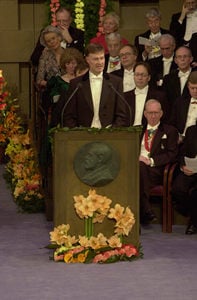
Copyright © Nobel Prize Outreach 2000 Photo: Hans Mehlin
Your Majesties, Your Royal Highnesses, Ladies and Gentlemen,
Chemistry! We all associate chemistry with test tubes, stinking laboratories and explosions – Alfred Nobel’s dynamite was born in such an environment. Perhaps the development of new knowledge in chemistry, more than any other science, has been characterized as a sparkling interplay between theory on one hand, the safe and predictable, and, on the other hand, the explosive and surprising reality. When we by chance discover something that may become valuable, we talk about “serendipity” – after the tale about the three princes of Serendip, who traveled widely and had the gift of drawing far-reaching conclusions from whatever they encountered. This year’s Nobel Prize in Chemistry is being awarded to three scientists, whose unexpected discovery gave birth to a research area of great importance.
But let us go back to the beginning. In Japan, in 1967, a group of scientists were studying the polymerization of acetylene into plastics – acetylene was the gas that the Swedish engineer Gustaf Dalén once tamed to bring light in the dark for sailors in the form of blinking buoys (1912 Nobel Prize in Physics). Polymerization is the process by which many small molecules react to form a long chain – a polymer. Professors Ziegler and Natta were awarded the 1963 Nobel Prize in Chemistry for a technique for polymerizing ethylene or propylene into plastics; the Japanese scientists used the same catalyst for polymerizing acetylene. One day a visiting researcher in the laboratory, the story goes, added more catalyst than written in the recipe: actually one thousand times too much! Imagine the surprise among your invited dinner guests if, rather than using a few drops of Tabasco in the soup, you had added the whole bottle! The result was a surprise also to the scientists. Instead of the expected black polyacetylene powder that normally was obtained, and that was of no use, a beautifully lustrous silver colored film resulted.
It was, however, only its appearance that was metallic. The material did not conduct electricity. The breakthrough was not made until ten years later in collaboration between physicist Alan Heeger and chemists Alan MacDiarmid and Hideki Shirakawa, continuing the experiments with the silver colored film. They tried to oxidize the film using iodine vapor, and – Bingo! The conductivity of the plastic increased by as much as ten million-fold; it had become conductive like a metal, comparable to copper. This was a surprising discovery, to the researchers as well as to others – we are all used to plastics, in contrast to metals, being insulators, which is why we cover electrical cords in plastic.
The discoverers started pondering what had happened. In order to conduct electricity the plastic would somehow have had to mimic metals, making their electrons easily mobile. Polyacetylene can be seen as beads on a string made up of carbon atoms linked by chemical bonds, alternatingly single and double bonds. It is the electrons of the double bonds that give rise to the electrical conductivity. But this only happens after oxidizing the polymer chain a little here and there, for example using iodine. And why is that? The iodine removes one electron from a carbon atom, thus creating a hole in the electronic structure into which an electron from a neighboring atom can jump, whereupon a new hole is formed and so on. A hole, i.e. lack of electron, corresponds to a positive charge, and the movement of the hole along the chain gives rise to a current.
The exciting idea of being able to combine the flexibility and low weight of plastics with the electric properties of metals has stimulated scientists all over the world, resulting in a novel research field bordering physics and chemistry. Various theoretical models and new conductive, but also semi-conductive, polymers followed during the 1980s in the wake of the first discoveries. Today we can see several possible applications. How about electrically luminous plastic that may be used for manufacturing mobile phone displays or the flat television screens of the future? Or the opposite – instead using light to generate electric current: solar-cell plastics that can be unfolded over large areas to produce environmentally friendly electricity. Finally, lightweight rechargeable batteries may be necessary if we are to replace the combustion engines in today’s cars with environmentally friendly electric motors – another application where electrical polymers might find use.
In parallel with the development of conducting polymers, there is an ongoing development of what we might call “molecular electronics,” where the very molecules perform the same tasks as the integrated circuits we just heard about in the Nobel Prize in Physics, with the difference that these could be made incomparably smaller. In laboratories around the world, scientists are working hard to develop molecules for future electronics. And among test tubes and flasks, and in the interplay between theory and experiment, we may some day again be astonished by something unexpected and fantastic. But this is a different story, and perhaps a different Nobel Prize …
Professors Heeger, MacDiarmid and Shirakawa.
You are being rewarded for your pioneering scientific work on electrically conductive polymers. Your serendipitous discovery of how polyacetylene could be made electrically conductive has led to the prolific development, pursued by yourself and by others, of a research field of great theoretical and experimental importance. It has inspired chemists and physicists all over the world to important collaborations, and has had, and will no doubt continue to have, consequences of great benefit to mankind.
May I convey to you my warmest congratulations on behalf of the Royal Swedish Academy of Sciences and ask you to come forward to receive the Nobel Prize in Chemistry for the year 2000 from the hands of His Majesty the King.
Nobel Prizes and laureates
Six prizes were awarded for achievements that have conferred the greatest benefit to humankind. The 14 laureates' work and discoveries range from quantum tunnelling to promoting democratic rights.
See them all presented here.