Gunnar Myrdal
Biographical
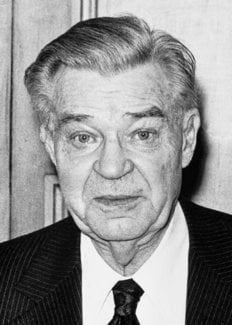
Gunnar Myrdal was born in Gustaf’s parish, Sweden, on December 6, 1898*. He graduated from the Law School of Stockholm University in 1923 and began practicing law while continuing his studies at the university. He received his juris doctor degree in economics in 1927 and was appointed docent in political economy. From 1925 to 1929 he studied for periods in Germany and Britain, followed by his first trip to the United States in 1929-1930 as a Rockefeller Fellow. During this period, he also published his first books, including The Political Element in the Development of Economic Theory. Returning to Europe, he first served for one year as Associate Professor in the Post Graduate Institute of International Studies, Geneva, Switzerland. In 1933 he was appointed to the Lars Hierta Chair of Political Economy and Public Finance at the University of Stockholm as the successor of Gustav Cassel. In addition to his teaching activities, Professor Myrdal was active in Swedish politics and was elected to the Senate in 1934 as member of the Social Democratic Party. In 1938, the Carnegie Corporation of New York commissioned him to direct a study of the American Negro problem. The material which he collected and interpreted was published in 1944 as An American Dilemma: The Negro Problem and Modern Democracy. Having come home to Sweden in 1942, he was re-elected to the Swedish Senate, served as member of the Board of the Bank of Sweden, and was Chairman of the Post-War Planning Commission. From 1945-1947, he was Sweden’s Minister of Commerce, a position which he left to accept an appointment as Executive Secretary of the United Nations Economic Commission for Europe. In 1957, he left this post to direct a comprehensive study of economic trends and policies in South Asian countries for the Twentieth Century Fund, which resulted in Asian Drama: An Inquiry into the Poverty of Nations and The Challenge of World Poverty. A World Anti-Poverty Program in Outline. From 1961, he was back in Sweden and was appointed Professor of International Economics at the Stockholm University. He founded this same year the Institute for International Economic Studies at the university and is still a member of its Directorate. He was Chairman of the Board of the Stockholm International Peace Research Institute (SIPRI) and remains a board member. He was also Chairman of the Board of the Latin American Institute in Stockholm. During the academic year 1973-1974, he was visiting Research Fellow at the Center for the Study of Democratic Institutions at Santa Barbara, California, and during 1974-1975, Distinguished Visiting Professor at New York City University. Professor Myrdal is recipient of more than thirty honorary degrees beginning with Harvard University in 1938, where he gave the Godkin Lectures that year. He has received many prizes, the last one being the Malinowski Award by the Society of Applied Anthropology. He is member of the British Academy, American Academy of Arts and Sciences, Vetenskapsakademien [the Royal Swedish Academy of Sciences], Fellow of the Econometric Society, honorary member of American Economic Association.
Gunnar Myrdal is married to the former Alva Reimer who held high posts in the United Nations and UNESCO, was the Swedish Ambassador to India and became Sweden’s Minister of Disarmament and of Church. They have three grown children, two daughters, Sissela and Kaj, and one son, Jan.
A complete bibliography of his scientific publications is presently under preparation by the Royal Library of Stockholm.
This autobiography/biography was written at the time of the award and first published in the book series Les Prix Nobel. It was later edited and republished in Nobel Lectures. To cite this document, always state the source as shown above.
* Gunnar Myrdal’s parents lived in Gustaf’s parish, but Gunnar was born in Skattungbyn.
Gunnar Myrdal died on May 17, 1987.
