Award ceremony speech
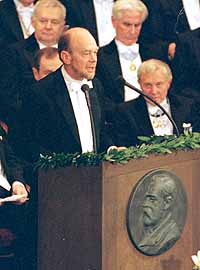
Professor Robert Erikson delivering the Presentation Speech for the 1998 Bank of Sweden Prize in Economic Sciences in Memory of Alfred Nobel at the Stockholm Concert Hall.
Copyright © Nobel Prize Outreach 1998
Photo: Hans Mehlin
Presentation Speech by Professor Robert Erikson of the Royal Academy of Sciences, December 10, 1998.
Translation of the Swedish text.
Your Majesties, Your Royal Highness, Ladies and Gentlemen,
How are we best to determine whether a society is developing for the better or the worse? This is a question which has occupied philosophers and social scientists for centuries. In a democracy, all answers to this question must contain some rule, which enables us to aggregate the social values, held by each and every member of society into one common value – a social preference.
The traditional theory of social choice, postulated that each individual is able to rank different social alternatives, according to the utility they represent for him or her. However, the theory did not postulate that it is possible to compare one person’s evaluation of a particular social alternative with that of another person. By not making interpersonal comparisons, a difficult philosophical issue is avoided, but it unfortunately makes it impossible to draw any interesting conclusions about inequality. As a basis for the aggregation of individual values to social preferences, this is a considerable drawback, since all social-ethical considerations worth the name, presuppose equality of some kind between people. Amartya Sen opened up a new field within the theory of social choice when he demonstrated how the possibility of identifying consistent social preferences, is affected by the assumptions we make about the kinds of interpersonal comparison that can be made. In doing this, he reintroduced the issue of distribution into the analysis. He also demonstrated which assumptions about individual preferences and their comparability we actually make when we apply established principles of moral philosophy. According to a utilitarian principle, for example, the best social state is the one which offers the highest average welfare. If we wish to apply this principle, we must be able to compare the differences among individuals in the personal utility offered by two social alternatives, in order to be able to determine which one of the two social states is the superior.
If we wish to compare the level of welfare in a number of countries, or look at the way it has changed over time in one specific country, we have to construct measures of welfare. Since social states can differ from each other in so many dimensions, we have to find ways of aggregating them in a consistent fashion. Amartya Sen’s results from his studies of the theory of social choice, have found an important application here. On the basis of his analysis of the comparability of individual welfare, he has proposed indicators for welfare, income inequality and poverty, which have since been put to extensive use. By deducing these indicators from a small number of reasonable axioms, he has made it easier to evaluate differing social states – if the axiom behind the indicator appears to be reasonable then the ranking according to the indicator will also be reasonable.
In its most extreme form, poverty leads to hunger, a problem which Amartya Sen has addressed in his extensive studies of the origins of famine. In these studies, he paved the way for a new view of famine and starvation, by modifying the usual assumption that famines are always linked to a reduction in the supply of food. Central to Sen’s analysis is that “the poor” should not be regarded as an undifferentiated mass, but that one should rather identify particular groups which have been struck by a catastrophic imbalance between needs and resources. Smallholders, farm labourers, tenant farmers and herdsmen may well all be poor, but the ways in which they are affected by famine can differ greatly. The severe drought in the Sahel region south of the Sahara in the early 1970s, undoubtedly reduced the food supply as a whole. However, the nomadic cattleherds were affected much more severely than were the non-nomadic farmers. The cattleherds live mainly off grain, which they buy with the money they make from selling their cattle. Even though many cattle died as a result of the drought, the price of cattle fell in relation to the price of grain, which left the nomads in a highly vulnerable situation and led to many deaths. Amartya Sen’s research has created a better basis for developing measures aiming at preventing and combating famine.
Dear Professor Sen,
You have applied a consistent approach in your studies of social choice, welfare measurement, and poverty. In theoretical and empirical work, you have deepened the understanding of these issues, making fundamental contributions to welfare economics. It is a great honour and privilege for me to convey to you, on behalf of the Royal Swedish Academy of Sciences, our warmest congratulations. I now ask you to receive the Prize from His Majesty the King.