Award ceremony speech
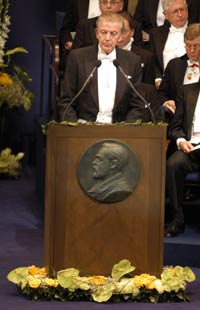
Professor Lars-Göran Nilsson delivering the Presentation Speech for the 2002 Bank of Sweden Prize in Economic Sciences in Memory of Alfred Nobel at the Stockholm Concert Hall.
Copyright © Nobel Prize Outreach 2002
Photo: Hans Mehlin
Presentation Speech by Professor Lars-Göran Nilsson of the Royal Swedish Academy of Sciences, December 10, 2002.
Translation of the Swedish text.
Your Majesties, Your Royal Highnesses, Ladies and Gentlemen,
Economic theory relies on the assumption that economic agents may be likened to a “homo oeconomicus”. This fictitious individual is usually governed by self-interest and makes his economic decisions by rationally evaluating the consequences of different alternatives, even in complex situations where the outcome is difficult to predict. Despite such strong assumptions, this approach has proved to be highly rewarding and has enhanced our understanding of many economic phenomena.
Empirical testing of postulates in economic theory confronts theoretical predictions with findings from real-world markets and economies. In general, however, since “field data” are affected by factors which scarcely allow for control and measurement, the identification of causal relationships is problematic. Whereas economists have had to overcome such obstacles by using ingenious statistical methods, many natural scientists have been able to rely on controlled experiments to test their theories.
These common descriptions of theoretical and empirical economic science may well have historical validity. But nowadays, they both have to be modified. With increasing confidence, researchers in psychological economics have been able to demonstrate that in some situations, individuals do not behave like “homo oeconomicus”. Researchers in experimental economics have developed methods for controlled laboratory experiments in economics. A number of scholars have contributed to this development, including previous Laureates: Maurice Allais and Herbert Simon thus brought psychological perspectives into into decision theory, while John Nash and Reinhard Selten conducted early experimental studies. But this year’s Laureates are the key figures in these two fields.
Daniel Kahneman has enriched economic analysis with fundamental insights from cognitive psychology, in particular regarding behavior under uncertainty. In collaboration with the late Amos Tversky, he conducted a series of classical experiments to reveal how human judgement under uncertainty adheres to systematic rules of thumb or shortcuts. They showed, for example, that most experimental subjects attribute equal credence to the mean values in small and large samples. This “law of small numbers” is contrary to the law of large numbers in probability theory, that is, the certainty in estimates of the mean value of a population provided by the sample mean increases with sample size. Systematic errors in probability estimates may have important consequences, particularly in financial markets. A timely illustration is that most of us have to choose a pension fund. If we adhere to the law of small numbers, funds with short-term returns well above average will attract many investors, even if this favorable outcome is due entirely to chance.
Kahneman has also formulated a new theory for decision-making under uncertainty, known as prospect theory. This theory can capture behavioral patterns in human decision-making better than traditional economic theory. A key element in prospect theory is that individuals compare uncertain outcomes with a reference level which depends on the decision situation, instead of evaluating the outcome according to an absolute scale. A further element is that individuals’ perception of probabilities is to some extent allowed to deviate from real predictions.
Whereas Kahneman studied human judgment and decisions on an individual basis, Vernon Smith has analyzed the interaction among individuals on markets. A reoccurring feature throughout his research is the development of feasible methods for carrying out economic experiments. The difficulties which arise in controlled experiments, where thinking people make economic decisions in the laboratory, are altogether different from those in experiments with elementary particles or cells. Smith has demonstrated ways of coping with these problems.
In one of his first experiments, Smith divided his subjects into buyers and sellers, after which he allowed them to bid for a good in accordance with given rules. Even though the subjects had not been informed about demand and supply conditions, Smith found that the prices in the laboratory converged towards a level close to the theoretical equilibrium price, where supply equals demand. Subsequent experiments verified that the general result was robust, but that price adjustment systematically depended on the precise rules governing the trade.
Auctions are used in many contexts, for example, in sales of government bonds and, in recent years, in privatization of former monopolies and distribution of transmission rights for mobile telephones. Economic theory makes clear predictions regarding the outcome of different auction methods, but they are difficult to test solely on the basis of observational data. Smith was able to conduct experiments that proved systematic relationships between the auction method and the average selling price, which in some cases coincide with – but in others deviate from – theoretical predictions.
In recent years, Smith has also demonstrated that experiments can be used in more complex situations, where economic theory does not provide precise results. In the same way that wind tunnel tests with prototypes can guide engineers before a real airplane is sent into the air, Smith has shown that laboratory experiments can guide economists before they launch new market methods, for instance in connection with deregulation or privatization.
Professor Kahneman: Insights from cognitive psychology have been instrumental in establishing new theoretical and empirical results; in ongoing research, they guide thought-provoking attempts to reformulate many aspects of economic and financial theory. The new bridges across disciplines can largely be attributed to your innovative research on the boundary between economics and psychology. Professor Smith: Economics used to be regarded as a non-experimental science. This is no longer so; nowadays, economic experiments are routinely conducted in specialized labs all over the world. Scale or ethics may limit economic experimentation, but the methods you have developed continue to enrich our empirical toolbox. Both of you have laid the foundations for an exciting renewal of economic research. It is a great honor for me to express, on behalf of the Royal Academy of Sciences, our warmest congratulations. I now ask you to step forward and receive your Prizes from His Majesty, the King.
