Eugenio Montale
Biographical
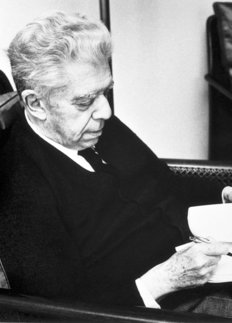 Eugenio Montale, born in 1896, is one of the few obvious “true masters” of the last fifty years of Italian literature. Born in Genoa into a family of businessmen, he discontinued his secondary studies and started, on a private basis, to study singing with the baritone Ernesto Sivori. But the 1915-18 war (in which he served as an infantry officer), the death of Sivori and his decision to go in for a literary career, turned Montale away from that course, in which he had shown an extraordinary interest in melodrama, even its technical aspects. When he started to devote himself to poetry, he was already in possession of a rich and versatile culture and a taste for Bellini’s and Debussy’s music, impressionist painting and the art of the great novelists of nineteenth-century Europe, at the same time sharing the interests of the Ligurian poets Roccatagliata-Cecardi, Boine and Sbarbaro. However, the “regional” outlook of the poetry of his time was not allowed to limit the critical attention that he paid to Leopardi and Foscolo. It was not until after the war that the poet dedicated himself fully to creative activities and literature. In 1921, he contributed to “Primo Tempo”, with Solmi and Debenedetti, revealing, besides his poetic gifts, a rare critical talent through his acuteness and independence of conventional patterns. His Omaggio a Svevo, published in 1925 in the Milanese paper “L’Esame”, aroused much attention, determining, among other things, the fortune of the works of the Triestine writer.
Montale settled down in Florence in 1928, where he became director of the Gabinetto Vieusseux library. He was one of the first inspirers of “Solaria”, always being one of the most active and politically non-conformist Florentine intellectuals until, in 1938, refusing to join the party then in power, he was dismissed from his directorship at the Gabinetto Vieusseux.
In 1925, he published his first collection of poems, Ossi di seppia, which quickly became one of the “classics” of contemporary Italian poetry; in his verses, sentiment appears desiccated by a severe intellectual rigour, evoked with intimate fullness in the fervid and striking sights of the Mediterranean landscape. Some critics aptly saw in Ossi di seppia a singular introspective continuity, as in a great modern novel, linked to the story of the protagonist, finding its most developed form in the poem “Arsenio”.
When Le occasioni (1939) was published, it brought consistent confirmation of this inner line of development which, bearing a new classical-modern imprint, identified itself with the great contemporary metaphysical poetry. In Le occasioni, Italian poetry and culture as a whole were, from then on, to recognise a book that reflected the solitude and the agony over the human condition of one who lucidly opposed Fascist oppression, creating a song of noble stoicism.
Montale’s biography is a chronicle of poetry. The Second World War saw the publication, in 1943, of Finisterre, a collection which, published in Lugano in two successive editions of modest print runs, constituted one of the cornerstones of the volume La bufera e altro, a consistent continuation of his whole work, printed in 1956. La farfalla di Dinard – which from the ninety-six pages of the 1956 edition was expanded, from one edition to another, into the 273 pages of the 1960 edition – showed Montale to be an original writer of autobiography and imaginative prose, almost a narrator, with malicious flashes of wit but with an elegiac spirit.
In 1961, Montale was awarded an honorary degree at the University of Rome and shortly afterwards, at the universities of Milan, Cambridge, and Basel. In 1967, President Saragat appointed him senator for life “in recognition of his distinguished achievements in the literary and artistic fields”. This event relieved him, in a sense, of the obligation to go every day to the editorial office of the “Corriere della Sera”, where he had been working as a music critic, editor and special correspondent since 1948. The following works, prose as well as poetry, confirmed the vitality of a writer who, true to the fundamental themes of his early career (the Universe marked by inevitable failure and pain as an existential stigma), managed to collect experiences and important moments from the spiritual transformations of our times. Auto da fé (1966 and 1972), Fuori di casa (1969 and 1975) and Quaderno di tradazioni (1948 and 1975) are books that give an idea of the vastness of his interests and of the versatility of his talent, later confirmed by La bufera e altro (1970).
In 1971, Mondadori published his fourth collection of poetry, Satura, which soon became a bestseller. The book, exhibiting the usual linguistic ambiguity typical of Montale, alludes to a poetry that disrupts its own and others’ patterns, including, in a paradoxical manner, much more than is usual (even for Montale) to include in the stylistic and linguistic models of poetry: meditative solicitations, existential themes about man still in some way Christian and Western, a wisdom anything but senile, subtle and provocative humor in the face of a world that changes and proceeds along its tragic and mysterious route.
Montale’s great poetry, in actual fact, is born out of the search for those presences that reveal and liberate the hidden world, such as spectres and amulets. Not insusceptible to the stylistic lessons of Pascoli and Gozzano, nor to contemporaries writing in English, Montale has in his turn influenced younger Italian poets, even post-Ermetismo poets and experimentators.
After a volume of cultural articles, La farfalla di Dinard, he published in 1973, still with Mondadori, Diario 1971-72, which contains more recent lyric poems, born of a moral meditation not very different from that which brought forth the poems of Satura.
Attentive to the effects of history, Montale’s poetry stands out as congenial to spirits that are aware of the consequences (of which, from many aspects, we have not yet seen the end) of the second world tragedy, which the writer saw as temporary reflections of an evil without origin and without end, according to a parable which makes him belong to the more conscious part of the European intellect.
Further works
Quaderno di quattro anni/It Depends. A Poet’s Notebook, tr. (poetry), 1977
L’opera in versi/Collected Poems (poetry), 1980
Eugenio Montale died in 1981.
This autobiography/biography was written at the time of the award and first published in the book series Les Prix Nobel. It was later edited and republished in Nobel Lectures. To cite this document, always state the source as shown above.
Eugenio Montale died on September 12, 1981.
Nobel Prizes and laureates
Six prizes were awarded for achievements that have conferred the greatest benefit to humankind. The 14 laureates' work and discoveries range from quantum tunnelling to promoting democratic rights.
See them all presented here.