Wole Soyinka
Biographical
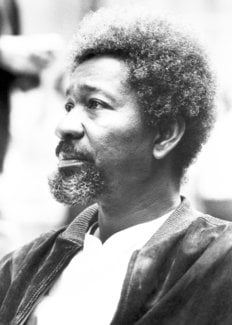
Wole Soyinka was born on 13 July 1934 at Abeokuta, near Ibadan in western Nigeria. After preparatory university studies in 1954 at Government College in Ibadan, he continued at the University of Leeds, where, later, in 1973, he took his doctorate. During the six years spent in England, he was a dramaturgist at the Royal Court Theatre in London 1958-1959. In 1960, he was awarded a Rockefeller bursary and returned to Nigeria to study African drama. At the same time, he taught drama and literature at various universities in Ibadan, Lagos, and Ife, where, since 1975, he has been professor of comparative literature. In 1960, he founded the theatre group, “The 1960 Masks” and in 1964, the “Orisun Theatre Company”, in which he has produced his own plays and taken part as actor. He has periodically been visiting professor at the universities of Cambridge, Sheffield, and Yale.
During the civil war in Nigeria, Soyinka appealed in an article for cease-fire. For this he was arrested in 1967, accused of conspiring with the Biafra rebels, and was held as a political prisoner for 22 months until 1969. Soyinka has published about 20 works: drama, novels and poetry. He writes in English and his literary language is marked by great scope and richness of words.
As dramatist, Soyinka has been influenced by, among others, the Irish writer, J.M. Synge, but links up with the traditional popular African theatre with its combination of dance, music, and action. He bases his writing on the mythology of his own tribe-the Yoruba-with Ogun, the god of iron and war, at the centre. He wrote his first plays during his time in London, The Swamp Dwellers and The Lion and the Jewel (a light comedy), which were performed at Ibadan in 1958 and 1959 and were published in 1963. Later, satirical comedies are The Trial of Brother Jero (performed in 1960, publ. 1963) with its sequel, Jero’s Metamorphosis (performed 1974, publ. 1973), A Dance of the Forests (performed 1960, publ.1963), Kongi’s Harvest (performed 1965, publ. 1967) and Madmen and Specialists (performed 1970, publ. 1971). Among Soyinka’s serious philosophic plays are (apart from “The Swamp Dwellers“) The Strong Breed (performed 1966, publ. 1963), The Road ( 1965) and Death and the King’s Horseman (performed 1976, publ. 1975). In The Bacchae of Euripides (1973), he has rewritten the Bacchae for the African stage and in Opera Wonyosi (performed 1977, publ. 1981), bases himself on John Gay’s Beggar’s Opera and Brecht’s The Threepenny Opera. Soyinka’s latest dramatic works are A Play of Giants (1984) and Requiem for a Futurologist (1985).
Soyinka has written two novels, The Interpreters (1965), narratively, a complicated work which has been compared to Joyce’s and Faulkner’s, in which six Nigerian intellectuals discuss and interpret their African experiences, and Season of Anomy (1973) which is based on the writer’s thoughts during his imprisonment and confronts the Orpheus and Euridice myth with the mythology of the Yoruba. Purely autobiographical are The Man Died: Prison Notes (1972) and the account of his childhood, Aké ( 1981), in which the parents’ warmth and interest in their son are prominent. Literary essays are collected in, among others, Myth, Literature and the African World (1975).
Soyinka’s poems, which show a close connection to his plays, are collected in Idanre, and Other Poems (1967), Poems from Prison (1969), A Shuttle in the Crypt (1972) the long poem Ogun Abibiman (1976) and Mandela’s Earth and Other Poems (1988).
This autobiography/biography was written at the time of the award and later published in the book series Les Prix Nobel/ Nobel Lectures/The Nobel Prizes. The information is sometimes updated with an addendum submitted by the Laureate.
Nobel Prizes and laureates
Six prizes were awarded for achievements that have conferred the greatest benefit to humankind. The 14 laureates' work and discoveries range from quantum tunnelling to promoting democratic rights.
See them all presented here.

