Sir Henry Dale
Biographical
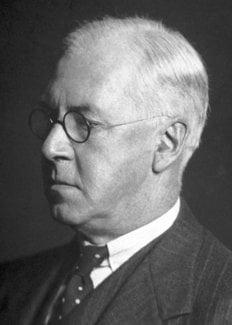
Henry Hallett Dale was born in London on June 9, 1875. He attended Leys School, Cambridge, and in 1894 he entered Trinity College with a scholarship. He graduated through the Natural Sciences Tripos, specializing in physiology and zoology. From 1898 to 1900 he was a Coutts-Trotter Student in Physiology at Trinity College, working then under J. N. Langley. In 1900 he gained a scholarship and entered St. Bartholomew’s Hospital, London, for the clinical part of the medical course. He qualified as B.Ch., Cambridge in 1903 and became M.D. in 1909. Meanwhile, he had been awarded the George Henry Lewes Studentship in Physiology and he used it to carry out research under Professor Starling at University College London. It was here that he met his lifelong friend, Otto Loewi. During 1903, he spent four months with Paul Ehrlich in Frankfurt before returning to University College as Sharpey Scholar. He held this post for only six months before he took an appointment as pharmacologist at the Wellcome Physiological Research Laboratories in 1904. He became Director of these laboratories in 1906, working for some six years with the chemical cooperation of George Barger.
In 1914, Dale was appointed Director of the Department of Biochemistry and Pharmacology at the National Institute for Medical Research in London, becoming in 1928 Director of this Institute; and he served in this capacity until his retirement in 1942 when he became Professor of Chemistry and a Director of the Davy-Faraday Laboratory at the Royal Institution, London. Since 1946, he has devoted his knowledge and energies to the administration of the Wellcome Trust for the support of medical research and medical scholarships. He has been a Trustee since 1936 and served as Chairman of the Board from 1938 until 1960. He was elected a Fellow of the Royal Society in 1914 and served as Secretary from 1925 to 1935. During World War II, Sir Henry served on several Advisory Committees to His Majesty’s Government. He was knighted in 1932 and appointed to the Order of Merit in 1944.
Sir Henry’s researches have involved a painstaking investigation of the pharmacology of ergot alkaloids and a study of the effects of incidental bases of a simpler nature, such as tyramine and histamine. He discovered the oxytocic action of pituitary extracts, and his continued work on the action of histamine led to studies on anaphylaxis and on conditions of shock. He identified acetylcholine as a constituent of certain ergot extracts, and an analysis of its action served as a basis for later researches, extending the application of Loewi’s discoveries, which have been recognized in the joint award of the Nobel Prize for 1936, given on account of the discoveries relating to chemical transmission of nerve impulses. In addition to numerous articles in medical and scientific journals which record his work, Sir Henry is the author of Adventures in Physiology (1953), and An Autumn Gleaning (1954).
Sir Henry was President of the Royal Society (1940-1945), President of the British Association (1947), and President of the Royal Society of Medicine (1948-1950). He has received many public honours including the G.B.E. (Knight Grand Cross, Order of the British Empire) in 1948, Medal of Freedom (Silver Palm), U.S.A., in 1947, the Grand-Croix de l’Ordre de la Couronne (Belgium) in 1950, and l’Ordre pour le Mérite (Western Germany) in 1955. The Royal and Copley Medals of the Royal Society, the Gold Albert Medal of the Royal Society of Arts, the Baly Medal of the Royal College of Physicians (London), the Cameron Prize (Edinburgh) and the Schmiedeberg plaquette from the German Pharmacological Society are among the many awards he has gained, and, in addition, he has been awarded fellowships of numerous learned societies and institutions throughout the world, including the Royal Society of Edinburgh and Trinity College, Cambridge. He is also a Foreign Associate of the National Academy of Sciences (Washington), Académie de Médecine (Paris) and l’Académie Royale de Belgique, as well as Academies in Denmark, Germany, Italy, Rumania, Spain, Sweden, U.S.A. (New York). He is the recipient of over twenty honorary degrees, and amongst the many lectures he has given are the Nothnagel Lecture (Vienna) and the Pilgrim Trust Lecture to the National Academy of Sciences, Philadelphia.
Sir Henry married Ellen Harriet Hallett, his first cousin, in 1904. Their eldest daughter, Alison Sarah, is married to Lord Todd, Nobel Laureate in Chemistry, 1957.
This autobiography/biography was written at the time of the award and first published in the book series Les Prix Nobel. It was later edited and republished in Nobel Lectures. To cite this document, always state the source as shown above.
Sir Henry Dale died on July 23, 1968.
Nobel Prizes and laureates
Six prizes were awarded for achievements that have conferred the greatest benefit to humankind. The 14 laureates' work and discoveries range from quantum tunnelling to promoting democratic rights.
See them all presented here.