Frederick C. Robbins
Biographical
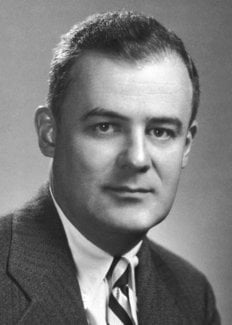
Frederick Chapman Robbins was born in Auburn, Alabama, on August 25, 1916. He is the son of William J. Robbins, a plant physiologist, who became Director of the New York Botanical Gardens, and Christine, née Chapman.
He was educated at the University of Missouri, where he took the A.B. degree in 1936 and the B.S. in 1938. In 1940 he graduated from Harvard Medical School and was appointed as resident physician in bacteriology at The Children’s Hospital Medical Center in Boston, Massachusetts. He continued his training there until 1942 when he left to serve in the United States Army.
During military service he was assigned to the Fifteenth Medical General Laboratory as Chief of the Virus and Rickettsial Disease Section, and in this capacity served in the United States, North Africa, and Italy. Most of his work during this period consisted of investigations on infectious hepatitis, typhus fever and Q fever, and supervision of a diagnostic virus laboratory. He has also studied the immunology of mumps. In 1945 he received the Bronze Star for Distinguished Service and at the time of discharge from the Army in 1946 held the rank of Major.
Returning to civilian life, Robbins resumed his training at The Children’s Hospital Medical Center and completed this in January 1948. From 1948 to 1950 he held a Senior Fellowship in Virus Diseases of the National Research Council and worked with Dr. John F. Enders in the Research Division of Infectious Diseases, The Children’s Hospital Medical Center. During this time he was a member of the Faculty of the Harvard Medical School. While he was working with Enders, Robbins chiefly studied the cultivation of poliomyelitis virus in tissue culture and the application of this technique. He also investigated the viruses of mumps, herpes simplex and vaccinia.
While in Boston, he was appointed Associate in Pediatrics on the Faculty of the Harvard Medical School, Associate in the Research Division of Infectious Diseases, and Associate Physician and Associate Director of the Isolation Service at The Children’s Hospital Medical Center, and also Research Fellow in Pediatrics at The Boston Lying-in Hospital and Assistant to the Children’s Medical Service, Massachusetts General Hospital.1
In May, 1952, he moved to Cleveland, Ohio, where he had been appointed Professor of Pediatrics at Western Reserve University School of Medicine and Director of the Department of Pediatrics and Contagious Diseases, Cleveland Metropolitan General Hospital, the position which he at present occupies.2
Robbins has served as Chairman of the Committee on Medical Education of Western Reserve University School of Medicine since 1958.
He is an associate member of the Commission on Viral Diseases of the Armed Forces Epidemiological Board, United States Department of Defense, of the Board of Scientific Counselors of the Division of Biologics Standards, Public Health Service, United States Department of Health, Education and Welfare, of the Physician’s Council, the Scientific Research Advisory Board of the National Association for Retarded Children; he is also Chairman of District V of the Committee on Medical Education of the American Academy of Pediatrics, and of the Awards Committee of this Academy, and served on the Public Health Council of the Ohio State Department of Health. He is also a consultant to the Infectious Diseases and Tropical Medicine Training Grant Award Committee of the National Institute of Allergy and Infectious Diseases, and to the Oregon Primate Research Center.
In 1955, John Carroll University of Cleveland conferred upon him the honorary degree of Doctor of Science, and in 1958, the University of Missouri, his alma mater, did the same.
In 1961 he was elected President of the Society for Pediatric Research, and in 1962 a member of the American Academy of Arts and Sciences.
Robbins married in 1948 Alice Havemeyer Northrop and they have two daughters, Alice Christine and Louise Enders.
1. During this time he continued to work with Dr. Enders.
2. Frederick C. Robbins is now University Professor and Dean Emeritus at the Case Western Reserve University.
This autobiography/biography was written at the time of the award and first published in the book series Les Prix Nobel. It was later edited and republished in Nobel Lectures. To cite this document, always state the source as shown above.
Addendum, August 2001
| Honors & Awards |
| Award for Distinguished Achievement (Modern Medicine), 1963 |
| Honorary Degree, Doctor of Laws, University of New Mexico, 1968 |
| Medical Mutual Honor Award, 1969 |
| Ohio Governor’s Award, 1971 |
| Honorary Fellow, All-India Institute of Medical Sciences, 1977 |
| Honorary Fellow, National Academy of Medical Sciences (India), 1977 |
| Honorary Degree, Doctor of Science, University of North Carolina, 1979 |
| Honorary Degree, Doctor of Science, Tufts University, 1983 |
| Honorary Degree, Doctor of Science, Medical College of Ohio, 1983 |
| Honorary Degree, Doctor of Science, Albert Einstein College of Medicine, 1984 |
| Honorary Degree, Doctor of Science, Medical College of Wisconsin, 1984 |
| Honorary Degree, Doctor of Medical Science, The Medical College of Pennsylvania, 1984 |
| Honorary Degree, Doctor of Laws, University of Alabama, Birmingham, 1985 |
| Abraham Flexner Award of AAMC for Distinguished Service to Medical Education, 1987 |
| Judge Baker Children’s Center Camille Cosby World of Children Award, 1988 |
| NASA Public Service Award, 1989 |
| Ohio Science and Technology Hall of Fame, 1992 |
| Case Western Reserve University Medical Alumni Assocication Board of Trustees Award, 1993 |
| Honorary Degree, Doctor of Science, honoris causa, Case Western Reserve University, May 24, 1992 |
| Frank and Dorothy Humel Hovorka Prize, Case Western Reserve University, May 22, 1994 |
| Honorary Degree, Doctor of Science, Kirksville College of Osteopathic Medicine, Kirksville, Missouri, June 7, 1998 |
| Benjamin Franklin Medal, American Philosophical Society, Philadelphia, PA, April 22, 1999 |
Frederick C. Robbins died on August 4, 2003.
Copyright © The Nobel Foundation 2001Nobel Prizes and laureates
Six prizes were awarded for achievements that have conferred the greatest benefit to humankind. The 14 laureates' work and discoveries range from quantum tunnelling to promoting democratic rights.
See them all presented here.