Louis Renault
Biographical
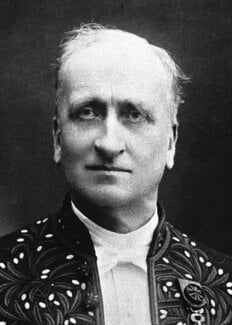
Although his active participation in efforts to solve the problems of international law brought him honor and respect from around the world, Louis Renault (May 21, 1843-February 8, 1918) was, in his own words1, «a professor at heart». Born at Autun in the Saône-et-Loire district of France, he received his love of learning as a heritage from his Burgundian father, a bookseller by vocation and bibliophile by avocation. Intellectually gifted, Renault was first in his class at the Collège d’Autun, taking prizes in philosophy, mathematics, and literature before going on to the University of Dijon for his bachelor’s degree in literature. For seven years, from 1861 to 1868, he studied law in Paris, receiving three degrees, the highest of them the doctoral and all of them with extraordinary honors.
In 1868 he began the career in the academic world which he never deserted. Twenty-five years old in 1868, he returned to Dijon as lecturer in Roman and then in commercial law. He joined the Faculty of Law of the University of Paris as an acting professor of criminal law in 1873, but he found his true field the next year when the opportunity arose to fill a temporary vacancy in international law. Although at first loath to change his primary field of interest, he continued in the new milieu and so distinguished himself in the next seven years by his teaching and by his publication of some fifty notes and articles and a book, Introduction à l’étude du droit international, that he was offered the chair of international law in 1881.
Renault’s scholarly output during his lifetime was extensive, making him the outstanding French authority on international law. He delivered countless lectures, wrote dozens of reports, published upwards of 200 notes and articles, most of them in law reviews and political science journals, and produced several books, of which the most important, in collaboration with his colleague, Charles Lyon-Caen, is the nine-volume Traité de droit commercial (1889-1899). Devoted to teaching as well as to research, he lectured for some years, concurrently with his appointment at the University of Paris, at the School of Political Sciences and at two of the military schools; he directed 252 doctoral theses2; he taught many students who later held important diplomatic posts in France and abroad.
Prior to 1890, Renault had participated in the solving of practical problems of international law, notably those of proprietary rights in literature and art and of the regulations governing submarine cables, but in the following years, having been appointed a legal consultant to the Foreign Office by Minister Alexandre Ribot, he became the «one authority in international law upon whom the Republic relied»3. For the next twenty years he was a French representative at innumerable international conferences held in Europe, figuring prominently in conferences on international private law, international transport, military aviation, naval affairs, circulation of obscene literature, abolition of white slavery, commercial paper used in international transactions, revision of the Red Cross Convention of 1864. In recognition of this and other services, Renault was accorded the titular rank of Minister Plenipotentiary and Envoy Extraordinary in 1903.
When the Hague Tribunal was opened to conduct cases of international arbitration, Renault was named one of its panel of twenty-eight arbiters. Voluntarily selected more times than any other member of the panel in the first fourteen years of the tribunal’s existence, Renault was involved in six of the court’s thirteen cases: the Japanese House Tax case between Japan on the one hand and Germany, France, and Great Britain on the other (1905); the Casablanca case between Germany and France (1909); the Savarkar case between France and Great Britain (1911); the Canevaro case between Italy and Peru (1912); the Carthage case between France and Italy (1913); and the Manouba case between France and Italy (1913).
At the first Hague Peace Conference of 1899, Renault was the reporter for the Second Commission, which was concerned with various questions governing naval warfare, and the principal drafter of the Final Act – the «summary» – of the Conference. A dominant figure at the second Hague Peace Conference in 1907, he was the reporter for the Conventions relating to the opening of hostilities, to the application of the Geneva Convention to naval warfare, to the creation of an international prize court, and to the defining of the rights and duties of neutral nations in naval war, as well as being on the drafting committee for the Final Act, which he presented.
The recipient of many honors for his accomplishments as teacher, scholar, judge, and diplomat, Renault was named to the Legion of Honor and to the Academy of Moral and Political Sciences in France, awarded decorations by nineteen foreign nations and honorary doctorates by several universities, and chosen to be president of the Academy of International Law created at The Hague in 1914.
Renault never retired. After teaching his last class on February 6, 1918, he went to his villa in Barbizon for a brief holiday, was taken ill, and died on the morning of February 8.
| Selected Bibliography |
| Fauchille, Paul, Louis Renault (1843-1918): Sa Vie, son oeuvre. Paris, Pedone, 1918. Contains a bibliography of Renault’s publications. |
| Renault, Louis, La Conférence navale de Londres: Déclaration relative au droit de la guerre maritime. Paris, Rousseau, 1909. |
| Renault, Louis, Les Conventions de La Haye (1896 et 1902) sur le droit international privé. Paris, Librairie de la Société du Recueil général, 1903. |
| Renault, Louis, Les Deux Conférences de la paix de 1899 et 1907: Recueil dex textes arrêtés par ces Conférences et de différents documents complémentaires. Paris, Rousseau, 1908. |
| Renault, Louis, First Violations of International Law by Germany: Luxembourg and Belgium, translated from the French by Frank Carr. London, Longmans, Green, 1917. (Les Premières Violations du droit des gens par l’Allemagne: Luxembourg et Belgique. Paris, Librairie du Recueil Sirey, 1907.) |
| Renault, Louis, Introduction à l’étude du droit international. Paris, Larose, 1879. |
| Renault, Louis, L’Oeuvre internationale de Louis Renault, 1843-1918: In Memoriam. 3 Tomes. Paris, Les Éditions internationales, 1932-1933. |
| Renault, Louis, «War and the Law of Nations in the 20th Century», translated from the French by George D. Gregory, in American Journal of International Law, 9 (1915) 1-16. [ «La Guerre et le droit les gens au XXe siècle» , Revue générale de droit international public, 21 (1914) 468.] |
| Renault, Louis, et É. Descamps, Recueil international des traités du XIXe siècle. Paris, Rousseau, 1913. |
| Renault, Louis, et Charles Lyon-Caen, Manuel de droit commercial spécialement destiné aux étudiants des Facultés de droit. Paris, Cotillon, Pichon, Durand-Auzias et Pichon, 1887. |
| Renault, Louis, et Charles Lyon-Caen, Précis de droit commercial. 2 Tomes. Paris, Cotillon, 1884-1885. |
| Renault, Louis, et Charles Lyon-Caen, Traité de droit commercial. 9 Tomes. Paris, Cotillon, Pichon, Durand-Auzias et Pichon, 1889-1899. |
| Renault, Louis, et Charles Lyon-Caen, Traité du droit maritime. Paris, 1894-1896. |
| Renault, Louis, et Charles Lyon-Caen, Traité des sociétés commerciales. Paris, 1892. |
| Schou, August, Histoire de l’internationalisme III: Du Congrès de Vienne jusqu’à la première guerre mondiale (1914), pp. 451-453. Publications de l’Institut Nobel Norvégien, Tome VIII. Oslo, Aschehoug, 1963. |
| Scott, James Brown, «In Memoriam: Louis Renault», in American Journal of International Law, 12 (July, 1918) 606-610. |
1. From a statement to his class in 1906; quoted by Paul Fauchille, Louis Renault, p. 2.
2. According to the list compiled by Fauchille, op.cit., pp. 235-243.
3. Scott, «In Memoriam: Louis Renault», American Journal of International Law, 12 (1918) 607.
This autobiography/biography was written at the time of the award and first published in the book series Les Prix Nobel. It was later edited and republished in Nobel Lectures. To cite this document, always state the source as shown above.
The Nobel Foundation's copyright has expired.Nobel Prizes and laureates
Six prizes were awarded for achievements that have conferred the greatest benefit to humankind. The 14 laureates' work and discoveries range from quantum tunnelling to promoting democratic rights.
See them all presented here.