Woodrow Wilson
Biographical
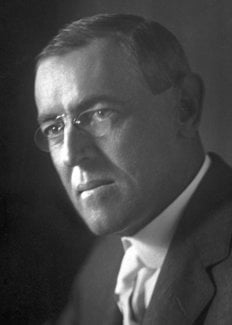
Thomas Woodrow Wilson (December 28, 1856-February 3, 1924) was born in Staunton, Virginia, to parents of a predominantly Scottish heritage. Since his father was a Presbyterian minister and his mother the daughter of a Presbyterian minister, Woodrow was raised in a pious and academic household. He spent a year at Davidson College in North Carolina and three at Princeton University where he received a baccalaureate degree in 1879.
After graduating from the Law School of the University of Virginia*, he practiced law for a year in Atlanta, Georgia, but it was a feeble practice. He entered graduate studies at Johns Hopkins University in 1883 and three years later received the doctorate. In 1885 he published Congressional Government, a splendid piece of scholarship which analyzes the difficulties arising from the separation of the legislative and executive powers in the American Constitution.
Before joining the faculty of Princeton University as a professor of jurisprudence and political economy, Wilson taught for three years at Bryn Mawr College and for two years at Wesleyan College. He was enormously successful as a lecturer and productive as a scholar.
As president of Princeton University from 1902 to 1910, Wilson became widely known for his ideas on reforming education. In pursuit of his idealized intellectual life for democratically chosen students, he wanted to change the admission system, the pedagogical system, the social system, even the architectural layout of the campus. But Wilson was a thinker who needed to act. So he entered politics and as governor of the State of New Jersey from 1911 to 1913 distinguished himself once again as a reformer.
Wilson won the presidential election of 1912 when William Howard Taft and Theodore Roosevelt split the Republican vote. Upon taking office he set about instituting the reforms he had outlined in his book The New Freedom, including the changing of the tariff, the revising of the banking system, the checking of monopolies and fraudulent advertising, the prohibiting of unfair business practices, and the like.
But the attention of this man of peace was forced to turn to war. In the early days of World War I, Wilson was determined to maintain neutrality. He protested British as well as German acts; he offered mediation to both sides but was rebuffed. The American electorate in 1916, reacting to the slogan «He kept us out of war», reelected Wilson to the presidency. However, in 1917 the issue of freedom of the seas compelled a decisive change. On January 31 Germany announced that «unrestricted submarine warfare» was already started; on March 27, after four American ships had been sunk, Wilson decided to ask for a declaration of war; on April 2 he made the formal request to Congress; and on April 6 the Congress granted it.
Wilson never doubted the outcome. He mobilized a nation – its manpower, its industry, its commerce, its agriculture. He was himself the chief mover in the propaganda war. His speech to Congress on January 8, 1918, on the «Fourteen Points» was a decisive stroke in winning that war, for people everywhere saw in his peace aims the vision of a world in which freedom, justice, and peace could flourish.
Although at the apogee of his fame when the 1919 Peace Conference assembled in Versailles, Wilson failed to carry his total conception of an ideal peace, but he did secure the adoption of the Covenant of the League of Nations. His major failure, however, was suffered at home when the Senate declined to approve American acceptance of the League of Nations. This stunning defeat resulted from his losing control of Congress after he had made the congressional election of 1918 virtually a vote of confidence, from his failure to appoint to the American peace delegation those who could speak for the Republican Party or for the Senate, from his unwillingness to compromise when some minor compromises might well have carried the day, from his physical incapacity in the days just prior to the vote.
The cause of this physical incapacity was the strain of the massive effort he made to obtain the support of the American people for the ratification of the Covenant of the League. After a speech in Pueblo, Colorado, on September 25, 1919, he collapsed and a week later suffered a cerebral haemorrhage from the effects of which he never fully recovered. He completed the remaining seventeen months of his term of office and lived in retirement for the last three years of his life.
| Selected Bibliography |
| Axson, Stockton, «Woodrow Wilson as Man of Letters», in The Rice Institute Pamphlet, 22 (October, 1935) 195-270. Three lectures on Wilson: «Heredity and Environment», «The Political Philosopher» and «The Literary Historian». |
| Bailey, Thomas A., Woodrow Wilson and the Peacemakers. New York, Macmillan, 1947. This book combines two books previously published separately: Woodrow Wilson and the Lost Peace (1944) and Woodrow Wilson and the Great Betrayal (1945). |
| Baker, Ray Stannard, Woodrow Wilson: Life and Letters. 8 vols. New York, Doubleday, 1927-1939. |
| Daniels, Josephus, The Wilson Era. 2 vols. Chapel Hill, N.C., University of North Carolina Press, 1946. |
| Link, Arthur S., Wilson. Princeton, Princeton University Press, 1947–. The five volumes published to date are: The Road to the White House (1947); The New Freedom (1956); The Struggle for Neutrality: 1914-1915 (1960); Confusions and Crises: 1915-1916 (1964); Campaigns for Progressivism and Peace: 1916-1917 (1965). |
| Phifer, Gregg, «Woodrow Wilson’s Swing around the Circle in Defense of His League», in Florida State University Studies, No. 23, pp. 65-102. Tallahassee, Fla., Florida State University, 1956. |
| Seymour, Charles, The Intimate Papers of Colonel House. 4 vols. New York, Houghton Mifflin, 1926. |
| Wilson, Woodrow, Congressional Government. New York, Houghton Mifflin, 1885. A modern edition of this book, Wilson’s first and best, may be found in Vol. 4 of The Papers of Woodrow Wilson, ed. by A.S. Link, pp. 6-179. |
| Wilson, Woodrow, A History of the American People. 5 vols. New York, Harper, 1902. |
| Wilson, Woodrow, The New Freedom: A Call for the Emancipation of the Generous Energies of a People. New York, Doubleday, 1913. |
| Wilson, Woodrow, The Papers of Woodrow Wilson, ed. by Arthur S. Link. Princeton, Princeton University Press, 1966. Eight volumes of this definitive work, covering the years 1856 to 1894, have been published to date. |
| Wilson, Woodrow, The Public Papers of Woodrow Wilson, ed. by Ray Stannard Baker and William E. Dodd. 6 vols. New York, Harper, 1925-1926. |
This autobiography/biography was written at the time of the award and first published in the book series Les Prix Nobel. It was later edited and republished in Nobel Lectures. To cite this document, always state the source as shown above.
* Woodrow Wilson also graduated from Princeton University (then the College of New Jersey).
The Nobel Foundation's copyright has expired.Nobel Prizes and laureates
Six prizes were awarded for achievements that have conferred the greatest benefit to humankind. The 14 laureates' work and discoveries range from quantum tunnelling to promoting democratic rights.
See them all presented here.