Cordell Hull
Biographical
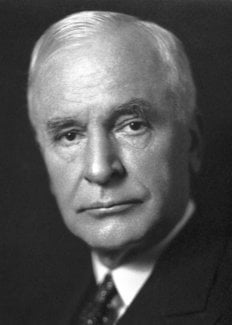
Cordell Hull (October 2, 1871-July 23, 1955) was born in a log cabin in Pickett County, Tennessee, the third of the five sons of William and Elizabeth (Riley) Hull. His father was a farmer and subsequently a lumber merchant. The only one of the five boys who showed an interest in learning, Cordell wanted to be a lawyer. He obtained his elementary school training in a one-room school that his father himself had built in nearby Willow Grove; then for a period of about three years he attended in succession the Montvale Academy at Celina, Tennessee, the Normal School at Bowling Green, Kentucky, and the National Normal University at Lebanon, Ohio. He received a law degree in 1891 after completing a one-year course at Cumberland University at Lebanon, Tennessee.
Not yet twenty, Hull began the practice of law in Celina, but having participated in political campaigning even while a student, decided to run for the state legislature as soon as he came of age. From 1893 to 1897 he was a member of the Tennessee House of Representatives, abandoning politics temporarily to serve as captain of the Fourth Tennessee Regiment in the Spanish-American War. Hull returned to the practice of law, this time in Gainsboro, Tennessee, but in 1903 was appointed judge of the Fifth Judicial District. He held this position until 1907, earning the nickname «Judge», used even by his wife, Rose Frances Whitney, whom he married in 1917.
Elected to Congress from the Fourth Tennessee District in 1907, Hull served as a U.S. representative until 1931, interrupted only by two years as chairman of the Democratic National Committee. In his distinguished career in Congress, Hull was a member of the powerful House Ways and Means Committee for eighteen years, the leader of the movement for low tariffs, the author of the first Federal Income Tax Bill (1913), the Revised Act (1916), and the Federal and State Inheritance Tax Law (1916), as well as the drafter of a resolution providing for the convening of a world trade agreement congress at the end of World War I. He became, in short, a recognized expert in commercial and fiscal policies.
Hull was elected U.S. senator for the 1931-1937 term but resigned upon his appointment as secretary of state by President Franklin D. Roosevelt on March 4, 1933. He was sixty-two. In 1944 when he resigned because of ill health, he had occupied this important post for almost twelve years, the longest tenure in American history.
His debut in this office was not auspicious. He headed the American delegation to the Monetary and Economic Conference in London in July, 1933, a conference which ended in failure despite the parlous state of world prosperity. On the heels of disaster came triumph. In November of that year he headed the American delegation to the seventh Pan-American Conference, held in Montevideo, and there won the trust of the Latin American diplomats, laying the foundation for the «good neighbor» policy among the twenty-one American nations so successfully followed up in the Inter-American Conference for the Maintenance of Peace held in Buenos Aires (1936), the eighth Pan-American Conference in Lima (1938), the second consecutive Meeting of Ministers of Foreign Affairs of the American Republics in Havana (1940).
Meanwhile, given authority through the Trade Agreements Act of 1934, he negotiated reciprocal trade agreements with numerous countries, lowering tariffs and stimulating trade.
Hull was responsive, also, to the problems arising in other parts of the globe. From 1936 on, foreseeing danger to peace in the rise of the dictators, he advocated rearmament, pled for the implementation of a system of collective security, supported aid short of war to the Western democracies, condemned Japanese encroachment into Indo-China, warned all branches of the U.S. military well in advance of the attack on Pearl Harbor to prepare to resist simultaneous, surprise attacks at various points. Although Hull participated in some of the policy making conferences of the Allies, his major effort during the later stages of World War II was that of preparing a blueprint for an international organization dedicated to the maintenance of peace and endowed with sufficient legislative, economic, and military power to achieve it. Although obliged because of the precarious state of his health to resign as secretary of state in late November, 1944, Hull nonetheless served as a member of and senior adviser to the American delegation to the United Nations Conference in San Francisco in 1945.
Hull did not possess the oratorical talent, the stylistic finesse, the brilliant charm, or the impressive personality so frequently characteristic of the politician who makes his way to the front benches. Tall and lean in figure, almost shy in manner, earnest and sincere in thought and deed, Hull had the power that comes to one who is thoroughly convinced of the rightness of his political and economic policies for peace and justice, is capable of defending them against all comers, and unwearying in his efforts to give them practical form.
| Selected Bibliography |
| Buell, Raymond Leslie, The Hull Trade Program and the American System. New York, Foreign Policy Association, 1938. |
| Hinton, Harold B., Cordell Hull: A Biography, with a Foreword by Sumner Welles. London and New York, Hurst & Blackett, 1942. |
| Hull, Cordell. The Hull papers are in the Manuscript Division of the Library of Congress. |
| Hull, Cordell, Addresses and Statements by the Hon. Cordell Hull, Secretary of State of the United States of America, in Connection with His Trip to South America to Attend the Inter-American Conference for the Maintenance of Peace, Held at Buenos Aires, Argentina, Dec. 1-23, 1936. Washington, D.C., U.S. Government Printing Office, 1937. |
| Hull, Cordell, Economic Barriers to Peace: Addresses on the Occasion of the Presentation of the Woodrow Wilson Medal to the Hon. Cordell Hull, N.Y., April 5, 1937. New York, Woodrow Wilson Foundation, 1937. |
| Hull, Cordell, The Memoirs of Cordell Hull. 2 vols. London, Hodder & Stoughton, 1948. |
| Hull, Cordell, The Moscow Conference: Addresses by Cordell Hull before a Joint Meeting of Both Houses of Congress, Nov. l8, 1943. Washington, D.C., U.S. Government Printing Office, 1943. |
| Hull, Cordell, The War and Human Freedom: Address by the Hon. Cordell Hull over AII National Radio Networks, Thurs., July 23, 1942. Washington, D.C., U.S. Government Printing Office, 1942. |
| Pratt, Julius W., Cordell Hull. 2 vols. Vols. XII and XIII of the American Secretaries of State and Their Diplomacy. New York, Cooper Square Publishers, 1964. |
This autobiography/biography was written at the time of the award and first published in the book series Les Prix Nobel. It was later edited and republished in Nobel Lectures. To cite this document, always state the source as shown above.
Nobel Prizes and laureates
Six prizes were awarded for achievements that have conferred the greatest benefit to humankind. The 14 laureates' work and discoveries range from quantum tunnelling to promoting democratic rights.
See them all presented here.