Alva Myrdal
Biographical
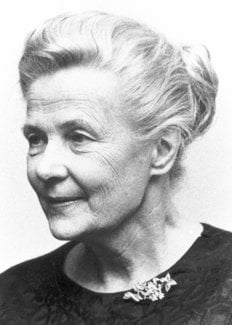
Alva Myrdal was born in Uppsala in 1902, graduated from University in 1924, and married Gunnar Myrdal the same year. Together with her husband she made a major contribution in the 1930s to the work of promoting social welfare. They were joint authors of a book entitled “The population problem in crisis”, and she was also actively engaged in the discussion on housing and school problems. She was a prominent member of the Social Democrat Party in Sweden, and in 1943 was appointed to that party’s committee with the task of drafting a post-war programme. Also in that year she was appointed to the Government Commission on International Post-War Aid and Reconstruction.
After the second world war she devoted more and more of her time and energy to international questions. In 1949 – 1950 she headed UNO’s section dealing with welfare policy, and in 1950 – 1955 she was chairman of UNESCO’s social science section. In 1955 she was appointed Swedish ambassador to India, and in 1962 was nominated Sweden’s representative to the Geneva disarmament conference. In that year she became a member of Parliament and in 1967 a member of the Cabinet, entrusted with the special task of promoting disarmament. For a number of years she has represented her country in UNO’s political committee, in which questions of disarmament have been dealt with.
During the negotiations in Geneva she played an extremely active role, emerging as the leader of the group of non-aligned nations which endeavoured to bring pressure to bear on the two super powers to show greater concern for concrete disarmament measures. Her experiences from the years spent in Geneva found an outlet in her book “The game of disarmament”, in which she expresses her disappointment at the reluctance of the USA and the USSR to disarm.
In her work for disarmament Alva Myrdal has combined profound commitment with great professional insight. With the support of experts she has familiarised herself with the scientific and technical aspects of the arms race. Her understanding of the need to base the work of disarmament on professional insight also found an outlet in her active participation in the establishment of the Stockholm International Peace Research Institute, SIPRI. Through her many articles and books Alva Myrdal has exercised a very significant influence on the current disarmament debate.
This autobiography/biography was written at the time of the award and later published in the book series Les Prix Nobel/ Nobel Lectures/The Nobel Prizes. The information is sometimes updated with an addendum submitted by the Laureate.
| Selected Bibilography |
| By Alva Myrdal |
| Dynamics of European Nuclear Disarmament. Nottingham: Spokesman, 1981. |
| The Game of Disarmament: How the United States and Russia Run the Arms Race. 1976. Rev. ed. New York: Pantheon, 1982. |
| Nation and Family. 2nd ed. Cambridge: MIT Press, 1965. |
| War, Weapons and Everyday Violence. Manchester: University of New Hampshire Press, 1977. |
| Women’s Two Roles. With V. Klein. Rev. ed. London: Routledge & Kegan Paul, 1968. |
| Other Sources |
| Bok, Sissela. Alva Myrdal: A Daughter’s Memoire. Reading Massachusetts: Addison-Wesley, 1991. (Highly recommended.) |
| Herman, Sondra R. “From International Feminism to Feminist Internationalism. The Emergence of Alva Myrdal, 1936-1955” Peace & Change 18, 4 (1993): 325-346. (An important interpretation, carefully researched.) |
This autobiography/biography was written at the time of the award and first published in the book series Les Prix Nobel. It was later edited and republished in Nobel Lectures. To cite this document, always state the source as shown above.
Alva Myrdal died on February 1, 1986.
Nobel Prizes and laureates
Six prizes were awarded for achievements that have conferred the greatest benefit to humankind. The 14 laureates' work and discoveries range from quantum tunnelling to promoting democratic rights.
See them all presented here.