Shimon Peres
Biographical
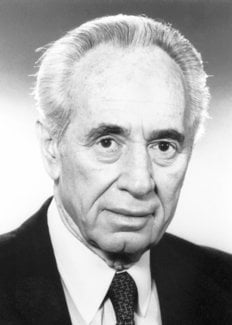
Shimon Peres (Labour), Minister of Foreign Affairs, was born in Poland in 1923 and immigrated with his family as a child. He studied at the Ben Shemen Agricultural School, and was one of the founders of Kibbutz Alumot in the Jordan Valley. In 1943, he was elected secretary of the Hano’ar Ha’oved youth.
In Israel’s War of Independence, Mr. Peres was responsible for arms purchases and recruitment, and in 1948 was appointed head of the naval services. In 1949, he headed the Defense Ministry’s procurement delegation to the United States.
Mr. Peres was appointed Deputy Director-General of the Ministry of Defense in 1952 and served as its Director-General between 1953-1959.
Mr. Peres has been a Member of the Knesset since 1959 and served as Deputy Minister of Defense from 1959-1965. In 1965, he left the Mapai Labour Party with Ben-Gurion and became Secretary-General of Rafi. In 1968, he was instrumental in bringing Rafi back to Mapai to form the Israel Labour Party.
Mr. Peres became Minister of Immigrant Absorption in 1969 and served as Minister of Transport and Communications from 1970-1974. In 1974 he was appointed Minister of Information and later, Minister of Defense (1974-1977). The highlight of his tenure as Defense Minister was the Entebbe rescue operation.
In 1977, Mr. Peres was elected chairman of the Labour Alignment. In 1984, a National Unity Government was formed, and he served first as its Prime Minister (1984-1986), and then as Vice Premier and Minister of Foreign Affairs (1986-1988). During his term as Prime Minister, Israel withdrew from Lebanon and an economic stabilization plan was implemented.
In 1978, Mr. Peres was elected Vice-President of the Socialist International.
In the National Unity government (1988-1990), Shimon Peres served as Vice Premier and Minister of Finance. From 1990-1992, he led the opposition in the Knesset.
Mr. Peres began his second tenure as Israel’s Minister of Foreign Affairs on July 13, 1992 with the establishment of the new, Labour-led government.
Shimon Peres has authoured the following books: The Next Step (1965); David’s Sling (1970); And Now Tomorrow (1978); From These Men (1979):;Entebbe Diary (1991); The New Middle East (1993); Battling for Peace (1995). He has written hundreds of articles and essays.
Shimon Peres is married to Sonya (nee Gelman); they have two sons and a daughter – and six grandchildren.
This autobiography/biography was written at the time of the award and later published in the book series Les Prix Nobel/ Nobel Lectures/The Nobel Prizes. The information is sometimes updated with an addendum submitted by the Laureate.
|
Selected Bibliography |
| General |
| Corbin, Jane. The Norway Channel. New York: Atlantic Monthly, 1994. By BBC reporter with good access to the negotiators. |
| Freedman, Robert Owen, ed. Israel under Rabin. Boulder: Westview, 1995. |
| Laqueur, Walter, and Barry Rubin, eds. The Israel-Arab Reader. A Documentary History of the Middle East Conflict. 5th rev. ed., PB, New York: Penguin, 1995. |
| Makovsky, David. Making Peace with the P.L.O.: The Rabin Government’s Road to the Oslo Accord. Boulder: Westview, 1996. By a diplomatic correspondent with critical perspective. Includes many documents. |
| Peleg, Ilan, ed. Middle East Peace Process: Interdisciplinary Perspectives. Albany, NY: State University of N.Y. Press, 1998. |
| Perry, Mark. A Fire in Zion. The Israeli-Palestinian Search for Peace. New York: Morrow, 1994. The background since 1988. By a well-informed journalist. |
| Said, Edward W. Peace and Its Discontents. Essays on Palestine in the Middle East Process. New York: Vintage PB, 1995. Eloquent critique of the Oslo Accords by a leading Palestinian-American intellectual. |
| Savir, Uri. The Process: 1,100 Days That Changed the Middle East. New York: Random House 1998. Hopeful inside view by chief Israeli negotiator. |
| Tessler, Mark. A History of the Israeli-Palestinian Conflict. Bloomington, Indiana: Indiana University Press, 1994. PB, scholarly and balanced. |
| Quandt, William B. The Peace Process: American Diplomacy and the Arab-Israeli Conflict since 1967. Washington, D.C.: Brookings, 1993. |
| By Shimon Peres |
| Peres, Shimon, with Arye Naor. The New Middle East. New York: Holt, 1993. His vision for the reconstruction of the region. |
| Peres, Shimon. Battling for Peace. A Memoir. Edited by David Landau. New York: Random House, 1995. |
| Peres, Shimon, and Robert Littell. For the Future of Israel. Baltimore, Md. and London: Johns Hopkins University Press, 1998. Conversations in 1996–7 with the novelist and former correspondent. |
| Peres, Shimon. A Time for War, A Time for Peace. Robert Laffont, 2004.* |
This autobiography/biography was written at the time of the award and first published in the book series Les Prix Nobel. It was later edited and republished in Nobel Lectures. To cite this document, always state the source as shown above.
* Updated by the Laureate in June 2005.
Addendum, June 2005
In January 2005, Peres joined Sharon’s government once again in his capacity as head of Israel’s Labor Party, serving as Vice Prime Minister. Among his areas of responsibility is the development of the Negev and the Galilee.
Shimon Peres died on 28 September 2016.
Copyright © The Nobel Foundation 2005Nobel Prizes and laureates
Six prizes were awarded for achievements that have conferred the greatest benefit to humankind. The 14 laureates' work and discoveries range from quantum tunnelling to promoting democratic rights.
See them all presented here.