Award ceremony speech
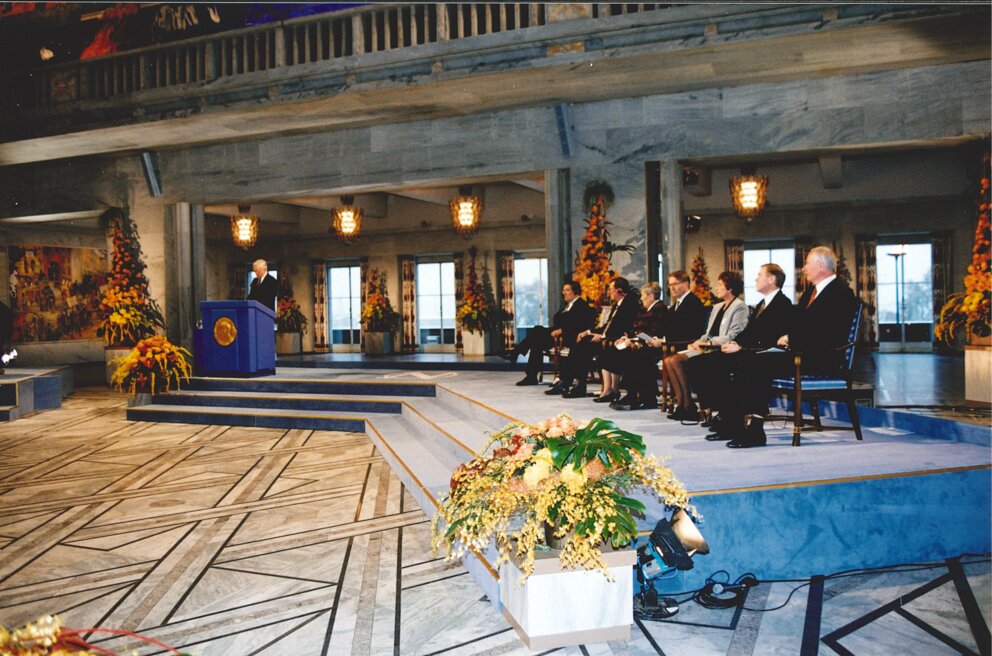
Professor Francis Sejersted delivering his speech.
© Knudsens fotosenter/Dextra Photo, Norsk Teknisk Museum.
Presentation Speech by Professor Francis Sejersted, Chairman of the Norwegian Nobel Committee, Oslo, December 10, 1998.
Translation of the Norwegian text.
Your Majesties, Excellencies, Ladies and Gentlemen,
On Good Friday this year, an agreement was signed which has rightly been seen as a breakthrough in the efforts to achieve a peaceful solution to the long-lasting conflict in Northern Ireland. In the referendum on 25 May, the agreement won the support of a large majority of the people, and in June elections were held to the Northern Ireland Assembly according to the principles laid down in the agreement. This autumn, formerly irreconcilable enemies have attended the Assembly together.
We all know that major problems still lie ahead, and that the new constitutional foundation for the peaceful resolution of conflicts is brittle. This autumn, too, we have witnessed terrorist attacks in which several people have been killed. But it does seem as if these have been isolated occurrences, and that they have only served to strengthen the general demand for building on the foundations for peaceful solutions laid in the Good Friday agreement. The IRA cease-fire, an important condition for progress towards peace, remains in force. So, although we are aware that things can change rapidly in our unsettled world, the situation has been a different one since Good Friday of this year. The vicious circle of violence has been broken. The peace process has built up a momentum of its own which makes a return to earlier conditions of terror unlikely, although we must be prepared for minor setbacks as the process continues.
The Norwegian Nobel Committee has chosen two men who in its opinion should be specially honoured for their contributions to the peace process, John Hume and David Trimble. It is with great pleasure that we welcome you to our cold but peaceful north to receive the Nobel Peace Prize for 1998. You are foremost among the many who have placed themselves at the service of peace, in and outside Northern Ireland.
John Hume and David Trimble are both from Northern Ireland, where they have lived with and in the conflict. They are both prominent politicians, leaders respectively of the two largest political parties in Northern Ireland, parties which represent the two groups in a divided population. They have both committed themselves to the course which the Good Friday agreement represents: that conflicts must be solved by peaceful means. The strong support for the agreement in the referendum shows that they made the right choice.
Political leadership is not to trim your sail to every wind; it is to initiate movement, and to act at the right time. Like other political leaders, the two Laureates have both helped to build confidence that it is possible to arrive at reasonable compromises by peaceful means. As political leaders, they are guarantors to their constituents that peaceful methods will lead to solutions which both sides can live with, and live better than if a state of war had continued. In a tense situation, such exposed positions require large amounts of both wisdom and courage. Today’s Laureates have shown both.
But there are differences between them. In 1970, at a time of spiralling violence, John Hume played a part in the foundation of the party of which he became the unquestioned leader, the Social Democratic and Labour Party (SDLP). It is a nationalist party, but it has stood firmly throughout for the principle that only peaceful means must be used. More than anyone else, Hume is the architect behind the peace process and the solution chosen in the Good Friday agreement. He has held unwaveringly to the line that discussions and institutional solutions have to be inclusive. Even those who had chosen violent means in their political struggle had to be given opportunities to participate in the peace process, to change their strategy, and to be taken at their word when they did so. Especially during periods of escalating violence, Hume has had to swallow sometimes very harsh criticism, from within his own ranks as well as from others, for his gentle approach to the hard-liners. But with his personal integrity, Hume has stood firm, and his policy has won through.
The Northern Irish Nobel Laureate in Literature, Seamus Heaney, used the fable of the hedgehog and the fox to describe our two Laureates and the difference between them. “John Hume is the hedgehog, who knew the big truth that justice had to prevail,” he wrote. David Trimble, on the other hand, “is the fox, who has known many things, but who had the intellectual clarity and political courage to know that 1998 was the time to move unionism towards an accommodation with reasonable and honourable nationalist aspirations. In so doing, he opened the possibility of a desirable and credible future for all the citizens of Northern Ireland.” When he was elected leader of Northern Ireland’s traditionally largest party, the Ulster Unionist Party (UUP), Trimble was a relative newcomer to top-level politics. He was known as an uncompromising unionist, but soon showed that he had other political sides to him, and clearly felt that the situation demanded more flexible attitudes on the part of the unionists. Under his leadership, enough fear and suspicion was overcome to enable a majority of unionists to rally behind the Good Friday agreement. I need hardly add that Trimble, too, has come in for strong criticism for his conciliatory approach.
Only those who have themselves experienced having their rights trampled on, who have seen their loved ones killed, who have had to live with loss, fear and suspicion, only they can fully grasp what it means to live under such conditions or wholly understand the reactions such a situation provokes. In her book “A Strategy for Peace”, the philosopher Sissela Bok, daughter of Peace Prize Laureate Alva Myrdal, writes about what she calls “The Pathology of Partisanship”, about how war can create in us a mental state which leaves us devoid of respect, even of pity, for even the most innocent victims. She recalls the writer Stephen Spender’s horror at finding that pathological condition in himself in the Spanish Civil War. Only through strong leadership and institutional guarantees can a society withstand such destructiveness, Sissela Bok concludes.
We who are looking on from the outside must be humble and slow to judge – judging is not our business. But the conflict does also involve us. It tells us something about ourselves by bringing general human features to light. The pathology of partisanship is one such feature. It tells us something about why violence engenders violence. It is remarkable, and promising, that despite such a cycle, despite the extremes in Northern Ireland, we are seeing more and more individuals standing up and proclaiming that forgiveness and reconciliation are more important than retaliation. Looking about us in the world, we see that people seeking peace following a violent past generally seem to find that the cry for justice must be subordinated to the call for reconciliation and amnesty. That is what we have learned for instance from South Africa. And who, after all, are the just in a situation like the one in Northern Ireland, with two clashing views of reality? Meanwhile we also learn, with Sissela Bok, how important strong leadership and institutional guarantees are in building up that desire for reconciliation which can move us away from a state of violence. Our Laureates stand for such leadership.
I have already mentioned that they have both been criticised for their moderate and inclusive approach. There has been so much fear and suspicion that for many it has become difficult to believe in the other party’s good intentions. The adoption of an inclusive strategy implies a deliberate break with suspicion, a disregard for fear. That, precisely, is the strategy of reconciliation. No doubt there are situations in which it is naive to believe in the other party’s good faith. To do so may be risky. But a real peace process needs people who are willing to take that risk. We need the bold – or, if you will, the credulous – people who are willing to stretch out a hand. It is surprising to see what a disarming effect innocence can sometimes have on the other party.
In addition to leadership, we need institutional guarantees, again according to Sissela Bok. The Good Friday agreement provides institutional guarantees. It neither represents nor was intended to represent any agreement at the substantive level. Unionists are still unionists and nationalists are still nationalists. What they have acquired are institutions for the peaceful resolution of conflicts.
Permit me a brief parallel with our own experience. In 1814, Norway was forced into a union with Sweden. War broke out on Norwegian soil between the Norwegian peasant army and the professional Swedish army which had returned from the continent after helping to defeat Napoleon. The fighting in Norway was brought to an end when the great powers intervened. They decided, Great Britain among them, that Norway must enter the union. But Norway was allowed to retain her new constitutional system. Armaments were replaced by political institutions. To reverse Clausewitz’s famous aphorism, politics became the continuation of war by other means. Ninety-one years later, the union was peacefully dissolved. The peaceful relation between the two parties was given symbolic expression when the Swede Nobel made the Norwegians responsible for awarding the Peace Prize.
In 1977, the Norwegian Nobel Committee awarded the Peace Prize for 1976 to Mairead Corrigan and Betty Williams, Northern Ireland’s Peace People. It has since been said that the time was not ripe. This time, too, we have heard that our choice may be premature, that lasting peace is still far to seek. The argument is easy to understand, and nothing could have pleased us more than to have been able to say today that peace was certain. But in connection with these awards, as with a number of others, the Committee bore in mind Nobel’s clear intention that the prize should reflect current affairs, and that it should advance the cause of peace. We know that a peace process may be long and difficult and suffer frequent reverses. In such processes, it is important to focus on the advances, made perhaps against the odds, and on the persons brave enough to stand up in a good cause. Reverses do not mean that their efforts have been in vain. They may have laid the foundations for renewed efforts at the next opportunity. That is how peace is built, slowly, like drilling through hard wood as Max Weber put it. The work along the way is just as important as the finishing touch. And it is by drawing attention to the present stage that one may perhaps contribute to further progress.
Our two Laureates have done great work in the cause of good. They have both shown great courage. So have many others: Gerry Adams, Bertie Ahern, Tony Blair and Bill Clinton, to name just a few of those who contributed most in the final stages of the process leading to the Good Friday agreement. United States Senator George Mitchell, who made such a significant contribution as a mediator, gave an accurate description of the work of our two Laureates, which I shall take the liberty of quoting: “Without Mr. Hume, there would have been no peace process, without Mr. Trimble, no agreement.” It is a privilege for us to be able to honour you here today. At the same time, we know there are many difficult tasks ahead. We take comfort from the fact that you will still be heading the process, and that you enjoy good strong support from many sides.
Nobel Prizes and laureates
Six prizes were awarded for achievements that have conferred the greatest benefit to humankind. The 14 laureates' work and discoveries range from quantum tunnelling to promoting democratic rights.
See them all presented here.