Edward V. Appleton
Biographical
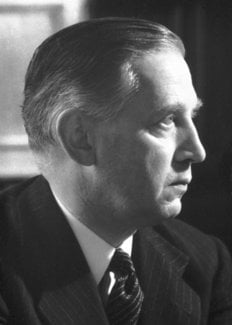
Edward Victor Appleton was born in Bradford, England, on 6th September, 1892, the son of Peter and Mary Appleton. He received his early education at Hanson Grammar School. Bradford then took his B.A. degree in Natural Science at St. John’s College, Cambridge,, in 1913 and 1914, with physics for Part II. He won the Wiltshire Prize in 1913 and the Hutchinson Research Studentship in 1914, studying under Sir J.J. Thomson and Lord Rutherford. During the First World War he joined the West Riding Regiment, transferring later to the Royal Engineers. At the conclusion of hostilities he returned to Cambridge and took up research on radio waves.
Since 1919 Appleton has devoted himself to scientific problems in atmospheric physics, using mainly radio techniques. In 1920 he was appointed assistant demonstrator in experimental physics at the Cavendish Laboratory. Two years later he became sub-rector at Trinity College.
In 1924 Appleton was appointed Professor of Physics at London University and served there for twelve years, returning to Cambridge in 1936 to take the Chair of Natural Philosophy.
In the latter part of 1924 Appleton began a series of experiments which proved the existence of that layer in the upper atmosphere now called the ionosphere. With the co-operation of the British Broadcasting Corporation the Bournemouth transmitter shot waves up to the layer to see if they were reflected by it and came back. The experiment was entirely successful, for the reflection was proved. Moreover, by a slight change of wavelength it was possible to measure the time taken by the waves to travel to the upper atmosphere and back. The position of the reflecting layer was thus identified and its height (60 miles above ground) determined. The method used was what is now called “frequency-modulation radar”. The ionosphere was thus the first “object” detected by radiolocation, and this led to a great development of radio research and to a military invention of the greatest importance in World War IL
Further experiments which led to the possibility of round-the-world broadcasting were carried out and in 1926 he discovered a further atmospheric layer 150 miles above ground, higher than the Heaviside Layer and electrically stronger. This layer, named the Appleton Layer after him, reflects short waves round the earth. Three years later Appleton made an expedition to Northern Norway for radio research, studying the Aurora Borealis and in 1931 he published the results of further research on determining the height of reflecting layers of the ionosphere, including the use of a transmitter that sent out “spurts” of radio energy, and the photography of the received echo-signals by cathode ray oscillography. In 1932 he was elected Vice-President of the American Institute of Radio Engineers.
When hostilities broke out in 1939 Appleton was appointed Secretary of the Department of Scientific and Industrial Research – the senior British Government post concerned with physical science.
Researches into the atmospheric layers and cathode ray oscillography were developed for aircraft detection when Sir Robert Watson-Watt and his group of scientists, working on Appleton’s findings, brought Britain’s secret weapon to perfection. Commonwealth researchers working with Appleton in Britain all became leaders in the development of radiolocation in their home countries and Sir Robert Watson-Watt has stated that, but for Appleton’s scientific work, radar would have come too late to have been of decisive use in the Battle of Britain. Appleton was knighted in 1941, being created K.C.B., and he was a member of the Scientific Advisory Committee of the War Cabinet which, in 1941, advised the Government that the manufacture of an atomic bomb was feasible. Later, under Sir John Anderson, and as technical head of the Department of Scientific and Industrial Research, he assumed administrative control of all British work on the subject. He paid a visit to the United States and Canada in 1943 to arrange details of collaboration between American and British scientists. He continued research work even during this arduous period and has demonstrated that ionospheric reflecting power varies with sunspot activities. Also, working with Dr. J.S. Hey of the Ministry of Supply, he discovered that sunspots are powerful emitters of short radio waves. An important result of Appleton’s work has been the establishment of a system of ionospheric forecasts, in which more than 40 stations all over the world co-operate, enabling the production of the most suitable wavelengths for communication over any particular radio circuit.
In 1947, the year in which he received the Nobel Prize for Physics, he was also awarded the highest civilian decoration of the United States – the Medal of Merit – and was made an Officer of the French Legion of Honour. He was also awarded the Norwegian Cross of Freedom for his war work. Appleton’s work has been recognized by India, Norway and Denmark, and in 1948 he was appointed by the Pope to the Pontificial Academy of Science. He received the Albert Medal of the Royal Society of Arts, in 1950, for outstanding services to science and industrial research and was elected President of the British Association for the Advancement of Science for the Liverpoo1 meeting in 1953. He has been Chairman of the British National Committee for Radio-Telegraphy and Honorary President of the International Scientific Radio Union. During the International Geophysical Year 1957-1958 he played an active part in the world planning of radio experiments as Chairman of the International Geophysical Year Committee of the Internationa1 Scientific Radio Union, and continues to remain a scientific research worker. He is now engaged on the interpretation of l.G.V. ionospheric measurements on a global basis.
In 1956 Sir Edward gave the Reith Lectures of the B.B.C. on “Science and the Nation”. Recent awards made to him have been the Gunning Victoria Jubilee Prize of the Royal Society, Edinburgh, in 1960, and the Medal of Honour of the Institute of Radio Engineers of America in 1962.
In 1915 Appleton married Jessie, daughter of the Rev. J. Longson, and they have two daughters.
This autobiography/biography was written at the time of the award and first published in the book series Les Prix Nobel. It was later edited and republished in Nobel Lectures. To cite this document, always state the source as shown above.
Sir Edward V. Appleton died on April 21, 1965.
Nobel Prizes and laureates
Six prizes were awarded for achievements that have conferred the greatest benefit to humankind. The 14 laureates' work and discoveries range from quantum tunnelling to promoting democratic rights.
See them all presented here.