Leptons and quarks


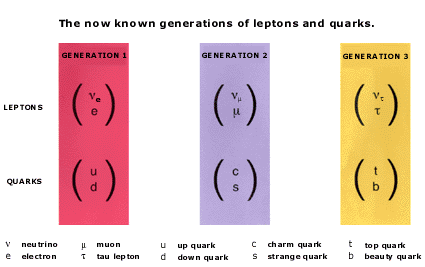
Matter is composed of two types of particles, leptons and hadrons. The hadrons are constructed of quarks, while the leptons do not seem to be constructed of other constituents. As the experiment of the Nobel Prize winners so convincingly showed, the leptons are grouped in pairs. This grouping into pairs also occurs for the quarks. According to the generally accepted model in particle physics, the standard model, the number of lepton pairs and quark pairs should be the same. A lepton pair and a quark pair are said to form a generation. The most elementary constituents of matter form three generations. Out of the six quarks and six leptons, the top quark and the tau neutrino have not yet been discovered, but particle physicists would be very surprised if they did not exist. Up to now the standard model describes very well how the forces between leptons and quarks act. Time will show whether there are more than three generations in the world of particles.
Nobel Prizes and laureates
Six prizes were awarded for achievements that have conferred the greatest benefit to humankind. The 14 laureates' work and discoveries range from quantum tunnelling to promoting democratic rights.
See them all presented here.