| |
 |
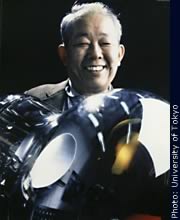
Masatoshi
Koshiba
International Centre for Elementary Particle
Physics, University of Tokyo, Japan |
| |
The
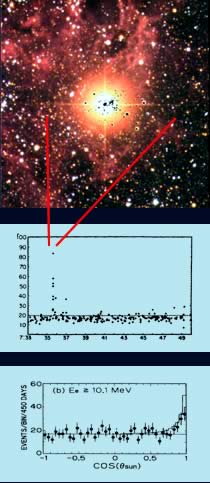
Supernova 1987A
The neutrinos arrived at
07:35 on
23 February 1987. Photo: The Anglo-Australian
Observatory |
 |
There is a clear increase in
the
signal for neutrinos coming from the
sun. |
|
|
KAMIOKANDE CAPTURED
NEUTRINOS IN WATER
Masatoshi Koshiba followed up on the measurements
made by Raymond Davis Jr by developing a large
water-filled detector, called Kamiokande, in a
Japanese mine. Kamiokande was direction sensitive and
could confirm Davis' discovery that neutrinos came
from the sun. The detector was operating on 23
February 1987 and detected 12 of the 1058
neutrinos emitted by supernova 1987A when it exploded
170,000 light years from the earth – the first
clear observation of neutrinos produced outside our
galaxy.
 |
 |
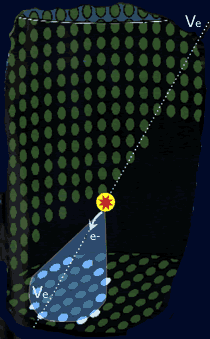
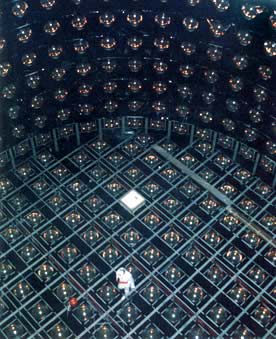
The
Kamiokande water tank was lined with
photomultipliers. When neutrinos enter the tank,
they can interact with electrons. These produce
flashes of light, which are registered by the
photomultipliers.
Photo: Kamioka Observatory |
|